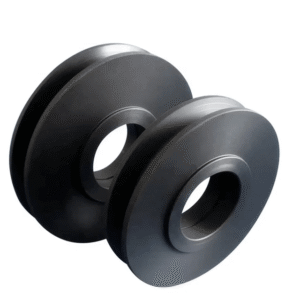


A pulley is a mechanical device used to transmit power, force, and motion in various systems.
It is designed as a wheel with grooves along its edge.
One of the important applications of a pulley is to increase or decrease speed and power in a power transmission system.

Pulleys are used in various industries such as industrial machinery, automobiles, electrical devices, and even sports equipment like gym machines.
They are usually connected to a power source (motors or electric engines) using a belt or wire rope and transfer motion and power from one location to another.

Foley type: Bushed taper (locking)
Material: Phosphate cast iron
Application: Machinery, road construction industry, stone crushing and cement industry, petrochemical oil and gas industries, transportation industry and production lines
Special feature: Faster installation and removal, no need for burrs or holes, if the bushing tipper breaks, it can be replaced at the lowest cost

Type of pulley: Timing pulley
Material:
Application: Used in automobiles, industrial machinery, robotics and automation, production lines
Outstanding feature: No slipping, ability to transmit at different speeds and torques, no need for lubrication, low noise and easy maintenance, long service life